Bachelor of Science Program in Science (Revised Curriculum for Academic Year 2024)
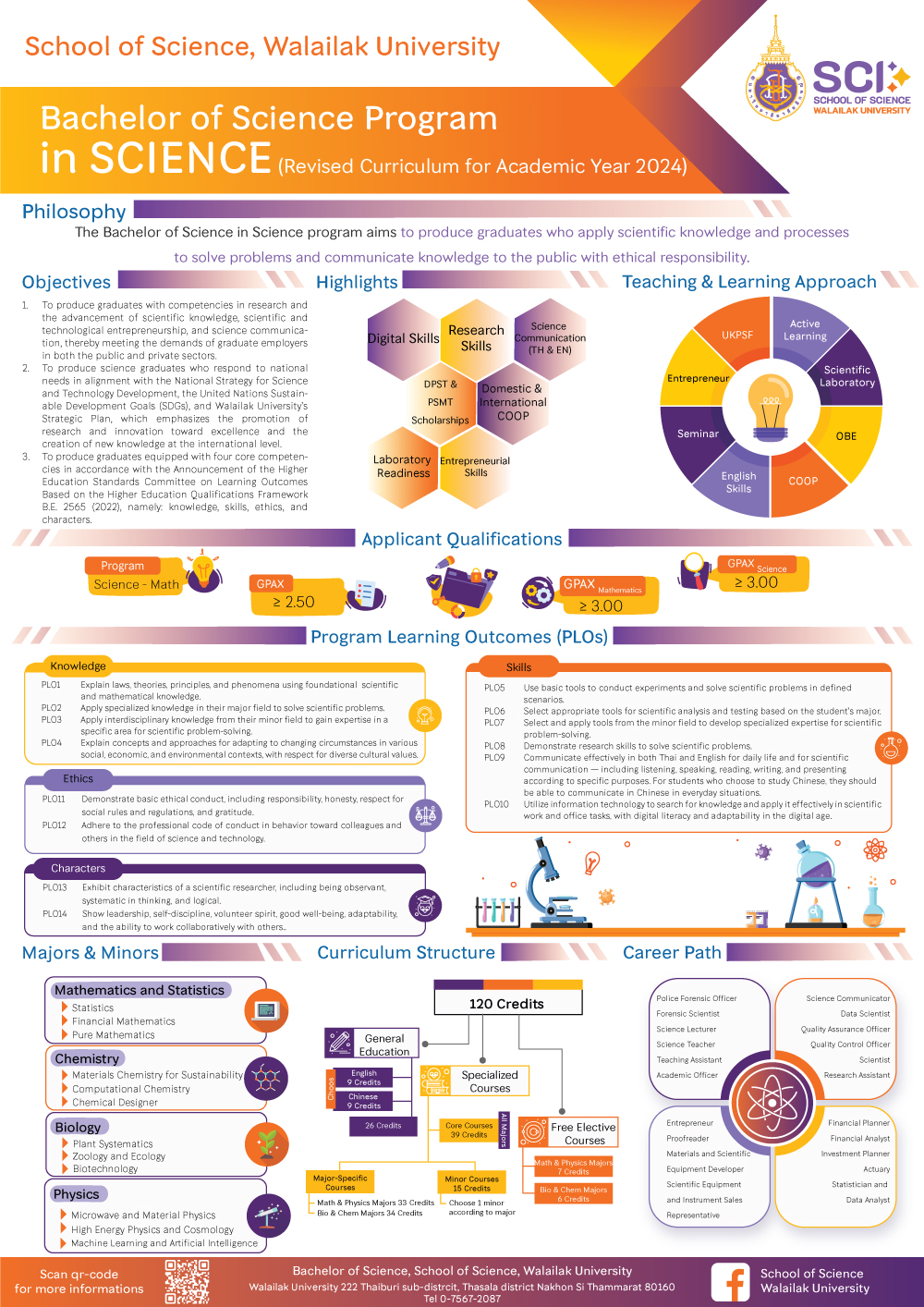
The Bachelor of Science in Science program aims to produce graduates who apply scientific knowledge and processes to solve problems and communicate knowledge to the public with ethical responsibility.
About Program
The science program comprises four major disciplines: Mathematics and Statistics, Chemistry, Biology, and Physics, and twelve minor subjects. In the first year, students will study foundational science subjects in all four disciplines, and then choose their major and minor subjects in the second semester of the first year. This is followed by foundational studies in their chosen major in the second year, and then minor subjects in their chosen major in the third and fourth years, based on their aptitude and interests. Furthermore, the program emphasizes practical skills and the use of various analytical instruments, and includes numerous academic and skill-enhancing activities throughout the curriculum.

Walailak University is a quality university aiming towards equipping graduates with abilities to enhance competitiveness in line with the motto, “Academic Excellence with Professional Skills.”
Academic excellence defines Walailak University’s teaching and learning practiced in consistency with The United Kingdom Professional Standards Frameworks (UKPSF). The graduates must be able to think analytically, synthetically and creatively.
Professional Skills are characterized by teaching and learning nourished through field practice, cooperative and work integrated education (CWIE).
Program Name (Thai) : หลักสูตรวิทยาศาสตรบัณฑิต สาขาวิทยาศาสตร์
Program Name (English) : Bachelor of Science Program in Science
Degree and Major
Thai : Full Name : วิทยาศาสตรบัณฑิต (วิทยาศาสตร์)
Abbreviation : วท.บ. (วิทยาศาสตร์)
English : Full Name : Bachelor of Science (Science)
Abbreviation : B.Sc. (Science)
- Emphasizes research skills for knowledge development and problem-solving in science, incorporating an entrepreneurial mindset to add value to research and benefit society.
- Enhances specialized digital skills in science for data management, computation, data analysis, and applications to scientific problem-solving.
- Develops communication skills in science, both in Thai and English, for writing and public speaking in general and academic contexts.
- Offers scholarships for gifted students in science and technology (DPST) and science/math teacher training (SMTE), and supports cooperative education placements in leading domestic and international institutions to produce competent science graduates ready for the job market.
- Implements teaching based on the United Kingdom Professional Standards Framework (UKPSF), with personalized student mentoring to foster well-rounded graduates with critical thinking, leadership, teamwork, and social adaptability.
1) Knowledge
PLO1 Explain laws, theories, principles, and phenomena using foundational scientific and mathematical knowledge.
PLO2 Apply specialized knowledge in their major field (Mathematics and Statistics, Chemistry, Biology, or Physics) to solve scientific problems.
PLO3 Apply interdisciplinary knowledge from their minor field to gain expertise in a specific area, which includes:
Mathematics and Statistics major
- Minor in Statistics or
- Minor in Financial Mathematics or
- Minor in Pure Mathematics
Chemistry major
- Minor in Sustainable Chemical Materials or
- Minor in Computational Chemistry or
- Minor in Chemical Design
Biology major
- Minor in Plant Systematics or
- Minor in Zoology and Ecology or
- Minor in Biotechnology
Physics major
- Minor in Microwave and Materials Physics or
- Minor in High Energy Physics and Cosmology or
- Minor in Machine Learning and Artificial Intelligence for scientific problem-solving
PLO4 Explain concepts and approaches for adapting to changing circumstances in various social, economic, and environmental contexts, with respect for diverse cultural values.
2) Skills
PLO5 Use basic tools to conduct experiments and solve scientific problems in defined scenarios.
PLO6 Select appropriate tools for scientific analysis and testing based on the student’s major, which may include Mathematics and Statistics (for Mathematics and Statistics majors), Chemistry (for Chemistry majors), Biology (for Biology majors), or Physics (for Physics majors).
PLO7 Select and apply tools from the minor field to develop specialized expertise, as follows
Mathematics and Statistics major
- Minor in Statistics or
- Minor in Financial Mathematics or
- Minor in Pure Mathematics
Chemistry major
- Minor in Sustainable Chemical Materials or
- Minor in Computational Chemistry or
- Minor in Chemical Design
Biology major
- Minor in Plant Systematics or
- Minor in Zoology and Ecology or
- Minor in Biotechnology
Physics major
- Minor in Microwave and Materials Physics or
- Minor in High Energy Physics and Cosmology or
- Minor in Machine Learning and Artificial Intelligence for scientific problem-solving
PLO8 Demonstrate research skills to solve scientific problems.
PLO9 Communicate effectively in both Thai and English for daily life and for scientific communication — including listening, speaking, reading, writing, and presenting according to specific purposes. For students who choose to study Chinese, they should be able to communicate in Chinese in everyday situations.
PLO10 Utilize information technology to search for knowledge and apply it effectively in scientific work and office tasks, with digital literacy and adaptability in the digital age.
3) Ethics
PLO11 Demonstrate basic ethical conduct, including responsibility, honesty, respect for social rules and regulations, and gratitude.
PLO12 Adhere to the professional code of conduct in behavior toward colleagues and others in the field of science and technology.
4) Character
PLO13 Exhibit characteristics of a scientific researcher, including being observant, systematic in thinking, and logical.
PLO14 Show leadership, self-discipline, volunteer spirit, good well-being, adaptability, and the ability to work collaboratively with others.
Mathematics and Statistics
Mathematician
Researcher
Academic Officer
Lecturer / Teacher
Financial Analyst
Actuary
Data Scientist
Production Planner
Meteorologist
Chemistry
Chemist
Researcher
Academic Officer
Lecturer / Teacher
Forensic Scientist
Forensic Police Officer
Quality Assurance (QA) Planner
Quality Control (QC) Officer
Chemical Product Development Specialist (e.g., cosmetics, food, etc.)
Biology
Researcher
Academic Officer
Lecturer / Teacher
Forensic Scientist
Laboratory Science Officer
Biochemist
Environmental Scientist
Biotechnician
Industrial Pollution Control System Operator
Environmental Consultant
Physics
Physicist
Researcher
Academic Officer
Lecturer / Teacher
Astronomer
Forensic Scientist
Metrologist
Medical Physicist
Radiological Operations Officer
Meteorologist
Systems Analyst
Software Developer
Data Scientist
Science Communicator
Physics Experimental Equipment Developer
Mathematics and Statistics Major
- Statistics
- Financial Mathematics
- Pure Mathematics
Chemistry Major
- Materials Chemistry for Sustainability
- Computational Chemistry
- Chemical Designer
Biology
- Plant Systematics
- Zoology and Ecology
- Biotechnology
Physics
- Microwave and Material Physics
- High Energy Physics and Cosmology
- Machine Learning and Artificial Intelligence
Tuition fee per semester: 23,700 THB
Total tuition fee for the entire program: 189,600 THB
Program Director: Asst.Prof.Dr. Theanchai Wiwasuku
Mathematics and Statistics
- Assoc.Prof.Dr. Kittipong Laipaporn
- Assoc.Prof.Dr. Janyarak Tongsomporn
- Assoc.Prof.Dr. Prathomjit Khachorncharoenkul
Chemistry
- Asst.Prof.Dr. Cholpisut Tantapakul
- Assoc.Prof.Dr. Piyaluk Nurerk
- Asst.Dr. Theanchai Wiwasuku
Biology
- Asst.Prof.Dr. Pimchanok Pimton
- Asst.Prof.Dr. Pakpimol Ungcharoenwiwat
- Asst.Prof.Dr. Witsanu Saisorn
Physics
- Assoc.Prof.Dr. Punsiri Dam-o Adamczyk
- Asst.Prof.Dr. Chairote Yaiprasert
- Asst.Prof.Dr. Sampart Cheedket
- Applicants must be legally residing in Thailand.
- Applicants must be currently studying in Grade 12, have completed Grade 12, or hold an equivalent qualification from any region of Thailand or from other countries.
- Applicants must be in good physical and mental health; they must not be legally incapacitated or mentally unsound.
- Applicants must possess a personality and demeanor that, in the opinion of the selection committee, do not constitute an obstacle to study or future professional practice.
- Applicants must not be drug addicts and must have no history of involvement with any type of narcotic drugs.
- GPA of at least 3.00 in all subjects
- Science–Mathematics study plan
Faculty Members Responsible for the Program
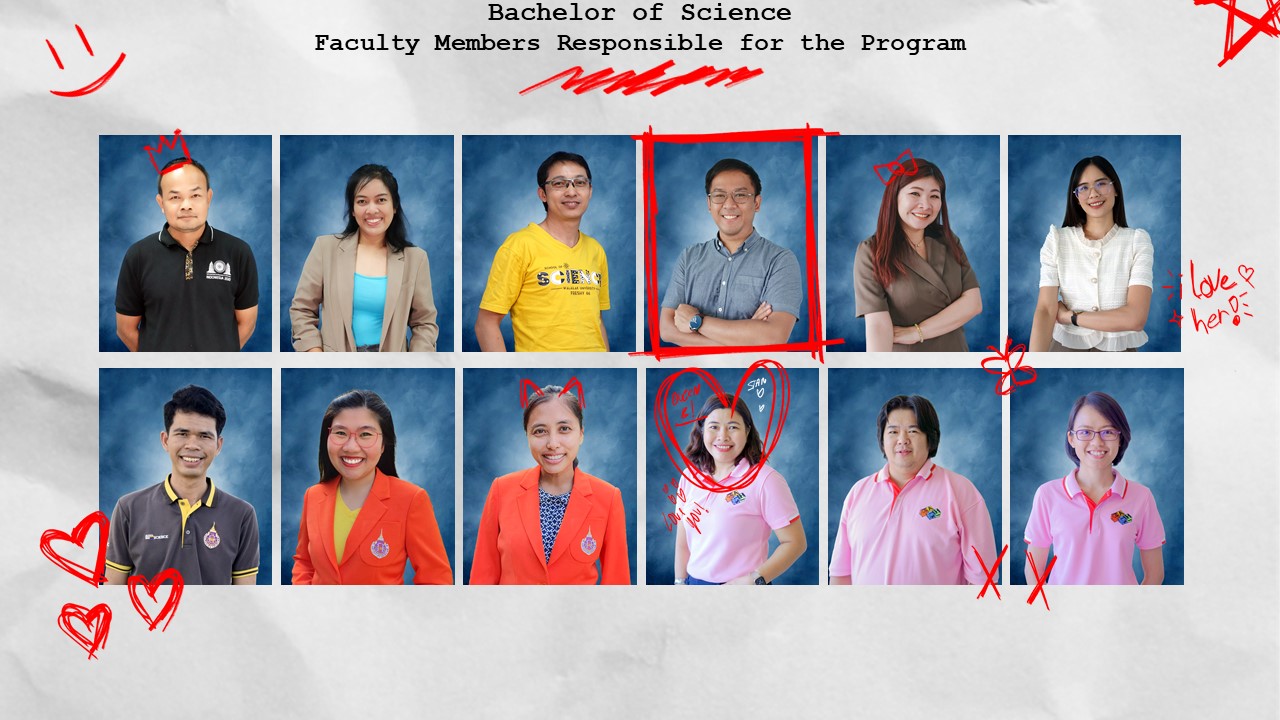
- Assoc.Prof.Dr. Kittipong Laipaporn
- Assoc.Prof.Dr. Janyarak Tongsomporn
- Assoc.Prof.Dr. Prathomjit Khachorncharoenkul
- Asst.Prof.Dr. Cholpisut Tantapakul
- Assoc.Prof.Dr. Piyaluk Nurerk
- Asst.Dr. Theanchai Wiwasuku
- Asst.Prof.Dr. Pimchanok Pimton
- Asst.Prof.Dr. Pakpimol Ungcharoenwiwat
- Asst.Prof.Dr. Witsanu Saisorn
- Assoc.Prof.Dr. Punsiri Dam-o Adamczyk
- Asst.Prof.Dr. Chairote Yaiprasert
- Asst.Prof.Dr. Sampart Cheedket
Curriculum Structure



General Education
- GEN67-011 Fundamental Thai | 2(2-0-4)*
- GEN67-111 Thai for Presentation | 2(2-0-4)
- GEN67-021 Fundamental English | 2(2-0-4)*
- GEN67-121 Integrated English Skills for Upper Beginners | 3(2-3-6)
Note: *Credits are not counted toward the curriculum structure.
Students may choose the remaining courses from one of the two foreign language groups: either 9 credits of English courses or 9 credits of Chinese courses.
English Courses 9 Credits
- GEN67-122 English Listening and Speaking for Basic Users | 3(2-3-6)
- GEN67-123 English Reading and Writing for Basic Users | 3(2-2-5)
- GEN67-124 English for Public Speaking and Presentation
for Independent Users | 3(2-2-5)
Chinese 9 Credits
- CHI67-121 Basic Chinese | 3(2-2-5)
- CHI67-122 Chinese for Daily Life | 3(2-2-5)
- CHI67-123 Chinese for Communication | 3(2-2-5)
- GEN67-133 Aesthetics for Quality of Life | 2(1-2-3)
- GEN67-141 Knowledge Inquiry and Fundamental Research | 2(2-0-4)
- GEN67-142 Environmental Conservation and Global Warming | 2(1-2-3)
- CSP67-151 Football | 1(0-2-1)
- CSP67-152 Futsal | 1(0-2-1)
- CSP67-153 Basketball | 1(0-2-1)
- CSP67-154 Volleyball | 1(0-2-1)
- CSP67-155 Badminton | 1(0-2-1)
- CSP67-156 Petanque | 1(0-2-1)
- CSP67-157 Tennis | 1(0-2-1)
- CSP67-158 Golf | 1(0-2-1)
- CSP67-159 Swimming | 1(0-2-1)
- CSP67-160 Thai Boxing | 1(0-2-1)
- CSP67-161 Table Tennis | 1(0-2-1)
- CSP67-162 Athletics | 1(0-2-1)
- CSP67-163 Weight Training) | 1(0-2-1)
- CSP67-164 Yoga for Health | 1(0-2-1)
- CSP67-165 Aerobic for Health | 1(0-2-1)
- GEN67-161 Innovation and Entrepreneurship | 2(1-2-3)
- INF67-171 Information Technology in Digital Era | 1(1-0-2)
- INF67-175 Web Development | 1(0-2-1)
Specialized Course
- MAT67-001 Basic Mathematics | 0(0-0-4)*
- SCM67-100 Essential Mathematics | 2(1-2-3)
- SCM67-101 Essential Statistics and Probability | 3(2-3-6)
- SCC67-100 Essential Chemistry | 3(2-2-5)
- SCC67-101 Essential Chemistry Laboratory | 1(0-3-2)
- SCB67-100 Essential Biology | 3(3-0-6)
- SCB67-101 Essential Biology Laboratory | 1(0-3-2)
- SCP67-100 Essential Physics | 3(2-2-5)
- SCP67-101 Essential Physics Laboratory | 1(0-3-2)
- SCI67-120 Scientific Programming | 2(1-2-3)
- SCI67-300 Science Communication | 2(1-3-4)
- SCI67-310 Science Innovation and Entrepreneur | 2(1-3-4)
- SCI67-330 Science Research Project | 3(0-9-5)
- SCI67-391 Pre-Cooperative Education | 1(0-2-1)
- SCI67-491 Cooperative Education I | 6(Practical training in cooperative education must involve no less than 40 hours of work per week.)
- SCI67-492 Cooperative Education II | 6(Practical training in cooperative education must involve no less than 40 hours of work per week.)
Note: *Credits are not counted toward the curriculum structure.
Mathematics and Statistics Major
- SCM67-102 Calculus I | 3(2-2-5)
- SCM67-103 Calculus II | 3(2-2-5)
- SCM67-104 Principles of Mathematics | 3(2-2-5)
- SCM67-105 Discrete Mathematics | 3(2-2-5)
- SCM67-106 Data Analysis | 3(2-3-6)
- SCM67-200 Calculus III | 3(2-2-5)
- SCM67-201 Linear Algebra | 3(2-2-5)
- SCM67-202 Financial Mathematics | 3(2-2-5)
- SCM67-203 Programming for Mathematics | 3(2-3-6)
- SCM67-204 Special Topics in Mathematics | 3(2-2-5)
- SCM67-300 Research Training in Mathematics | 3(2-2-5)
- SCM67-210 Regression Analysis | 3(2-3-6)
- SCM67-211 Introduction to Time Series Analysis | 3(2-3-6)
- SCM67-310 Design of Experiments | 3(2-3-6)
- SCM67-311 Introduction to Multivariate Analysis | 3(2-3-6)
- SCM67-312 Selected Topics in Statistics | 3(2-3-6)
- SCM67-220 Operation Research | 3(2-2-5)
- SCM67-221 Real Analysis | 3(2-2-5)
- SCM67-320 Probability Theory | 3(2-2-5)
- SCM67-321 Stochastic Processes and Their Applications | 3(2-2-5)
- SCM67-322 Selected Topics in Financial Mathematics | 3(2-2-5)
- SCM67-230 Theoretical Differential Calculus | 3(2-2-5)
- SCM67-231 Abstract Algebra | 3(2-2-5)
- SCM67-330 Theoretical Integral Calculus | 3(2-2-5)
- SCM67-331 Selected Topics in Mathematics I | 3(3-0-6)
- SCM67-332 Selected Topics in Mathematics II | 3(2-2-5)
Chemistry Major
- SCC67-120 Inorganic Chemistry Laboratory | 1(0-3-2)
- SCC67-121 Inorganic Chemistry I | 3(2-2-5)
- SCC67-130 Physical Chemistry Laboratory | 1(0-3-2)
- SCC67-131 Physical Chemistry I | 3(2-2-5)
- SCC67-140 Analytical Chemistry Laboratory | 1(0-3-2)
- SCC67-141 Analytical Chemistry I | 3(2-2-5)
- SCC67-200 Chemical Management and Safety in the Chemistry Laboratory | 2(1-3-4)
- SCC67-210 Organic Chemistry Laboratory | 1(0-3-2)
- SCC67-211 Organic Chemistry I | 3(2-2-5)
- SCC67-212 Organic Chemistry II | 2(2-0-4)
- SCC67-221 Inorganic Chemistry II | 2(2-0-4)
- SCC67-222 Principles and Experiments of Spectroscopy for Inorganic and Organic Compounds | 3(2-3-6)
- SCC67-231 Physical Chemistry II | 2(2-0-4)
- SCC67-241 Analytical Chemistry II | 2(2-0-4)
- SCC67-300 Research Methods in Chemistry | 1(0-3-2)
- SCC67-310 Biochemistry Laboratory | 1(0-3-2)
- SCC67-311 Biochemistry | 3(2-2-5)
- SCC67-321 Advanced Functional Materials for Sustainable Applications) | 3(2-2-5)
- SCC67-322 การสังเคราะห์และปฏิกิริยาสำหรับวัสดุเชิงฟังก์ชัน (Synthesis and Reaction for Functional Materials) | 3(2-3-6)
- SCC67-323 สเปกโทรสโกปีของรังสีเอกซ์สําหรับวัสดุอนินทรีย์ (X-ray Spectroscopy for Inorganic Materials) | 2(1-3-4)
- SCC67-324 การพิสูจน์เอกลักษณ์วัสดุเคมี (Chemical Materials Characterization) | 3(2-3-6)
- SCC67-325 การทดลองทางเคมีที่ยั่งยืน (Sustainable Chemistry Experiment) | 1(0-3-2)
- SCC67-326 เคมีสีเขียวและการพัฒนาที่ยั่งยืน (Green Chemistry and Sustainable Development) | 3(2-2-5)
- SCC67-351 Basic Molecular Modeling for Chemists Laboratory | 1(0-3-2)
- SCC67-352 Basic Molecular Modeling for Chemists | 3(3-0-6)
- SCC67-353 Computational Chemistry for Molecular Spectroscopy Laboratory | 1(0-3-2)
- SCC67-354 Computational Chemistry for Molecular Spectroscopy | 2(2-0-4)
- SCC67-355 Basic Molecular Simulation for Chemists Laboratory | 1(0-3-2)
- SCC67-356 Basic Molecular Simulation for Chemists | 3(3-0-6)
- SCC67-357 Molecular Design for Chemistry Laboratory | 1(0-3-2)
- SCC67-358 Molecular Design for Chemistry | 3(3-0-6)
- SCC67-341 Chemical Instruments for Design Thinking and Process Design | 3(2-2-5)
- SCC67-342 Validation and Assessment of Control Measures | 3(2-2-5)
- SCC67-361 Real World Chemistry | 3(2-2-5)
- SCC67-362 Design Thinking for Chemists | 3(2-2-5)
- SCC67-363 Process Design for Chemists | 3(2-2-5)
Biology Major
- SCB67-120 Genetics and Molecular Genetics | 3(3-0-6)
- SCB67-121 Genetics and Molecular Genetics Laboratory | 1(0-3-2)
- SCB67-170 Cell Biology | 3(3-0-6)
- SCB67-171 Cell Biology Laboratory | 1(0-3-2)
- SCB67-210 Microbiology | 3(3-0-6)
- SCB67-211 Microbiology Laboratory | 1(0-3-2)
- SCB67-230 Zoology | 3(3-0-6)
- SCB67-231 Zoology Laboratory | 1(0-3-2)
- SCB67-240 Botany | 3(3-0-6)
- SCB67-241 Botany Laboratory | 1(0-3-2)
- SCB67-250 Principles of Ecology | 3(3-0-6)
- SCB67-251 Principles of Ecology Laboratory | 1(0-3-2)
- SCB67-350 Evolution | 3(3-0-6)
- SCC67-310 Biochemistry Laboratory | 1(0-3-2)
- SCC67-311 Biochemistry | 3(2-2-5)
- CHM67-112 Principles of Organic Chemistry | 3(2-2-5)
- SCB67-190 Field Trip in Plant Systematics | 1(0-3-2)
- SCB67-242 Plant Anatomy | 3(2-3-6)
- SCB67-260 Plant Systematics | 3(2-3-6)
- SCB67-340 Pteridology | 3(3-0-6)
- SCB67-341 Plant Biotechnology | 3(2-2-5)
- SCB67-380 Research Training in Plant Systematics | 2(0-6-3)
- SCB67-191 Field Trip in Zoology and Ecology | 1(0-3-2)
- SCB67-232 Invertebrate | 3(2-2-5)
- SCB67-233 Vertebrate | 3(3-0-6)
- SCB67-351 Animal Ecology | 3(2-3-6)
- SCB67-352 Behavioral Ecology | 3(2-2-5)
- SCB67-381 Research Training in Zoology and Ecology | 2(0-6-3)
- SCB67-192 Field Trip in Biotechnology | 1(0-3-2)
- SCB67-212 Applied Microbiology and Biotechnology | 3(2-3-6)
- SCB67-213 Antimicrobial Development | 3(3-0-6)
- SCB67-270 Molecular Biology | 3(2-2-5)
- SCB67-370 Cell and Developmental Biology | 3(2-2-5)
- SCB67-382 Research Training in Biotechnology | 2(0-6-3)
Physics Major
- SCP67-111 Mathematics for Physics I | 2(1-3-4)
- SCP67-112 Mathematics for Physics II | 2(1-3-4)
- SCP67-121 Classical Mechanics I | 2(1-3-4)
- SCP67-122 Modern Physics | 3(3-0-6)
- SCP67-123 Intermediate Physics Laboratory | 1(0-3-2)
- SCP67-131 Astronomy | 3(3-0-6)
- SCP67-211 Computer Programming for Physics | 2(1-3-4)
- SCP67-213 Computer Simulation in Physics | 2(1-3-4)
- SCP67-221 Classical Mechanics II | 3(2-2-5)
- SCP67-222 Electromagnetic Theory | 3(3-0-6)
- SCP67-223 Quantum Mechanics | 3(3-0-6)
- SCP67-224 Advanced Physics Laboratory | 1(0-3-2)
- SCP67-225 Thermal Physics and Statistical Mechanics | 3(2-2-5)
- SCP67-231 Introduction to Electronics and Internet of Things | 2(1-3-4)
- SCP67-232 Seminar in Physics Application in the Recent World | 1(0-2-1)
- SCP67-151 Material Physics and Technology | 3(3-0-6)
- SCP67-251 Microwave and Material Interactions | 3(2-3-6)
- SCP67-252 Advanced Material Characterization | 3(3-0-6)
- SCP67-351 Solid State Physics | 3(3-0-6)
- SCP67-352 Physics of Plasma and Application | 3(3-0-6)
- SCP67-261 Nuclear Physics | 3(2-2-5)
- SCP67-262 General Relativity Theory | 3(2-2-5)
- SCP67-263 Field Theory | 3(2-2-5)
- SCP67-361 Introduction to Elementary Particle Physics | 3(2-2-5)
- SCP67-362 Cosmology | 3(2-2-5)
- SCP67-271 Introduction to AI and Data Science | 3(2-3-6)
- SCP67-272 Natural Language Processing | 3(2-3-6)
- SCP67-273 Machine Learning | 3(2-3-6)
- SCP67-274 Data Mining | 3(2-3-6)
- SCP67-275 Internet of Things | 3(2-3-6)
Scholarship

College Life
Our Social Media